Losing most or all of your teeth can change how you eat, speak and look after your oral health. Full mouth dental implants are one way to replace a whole arch of teeth, and the right approach depends on far more than the number of teeth missing.
At Crown Dental Group, we take time to assess your teeth, gums and jaw bone before discussing any treatment, so your options are based on your individual situation.
Below, we explain the main options, what each stage involves, what the research shows, and what affects cost.
Full mouth dental implants replace all of the upper or lower teeth, or both, using implants as artificial tooth roots. Instead of one implant for each tooth, a full arch of prosthetic teeth is usually attached to four to six implants placed in the jaw bone.
An implant is a small post that sits in the bone where a tooth root used to be. Most are titanium implants, though other materials exist. Over around three months, bone usually grows around the implant and holds it in place. The final teeth are then fixed to the implants.
You may also hear these called full arch dental implants, full mouth implants or arch dental implants. They all describe the same general idea: replacing a whole row of teeth with a bridge supported by implants rather than by the gums alone.
Tooth loss of this kind is more common than many people expect. In 2017 to 2018, about 1 in 25 Australian adults had lost all of their natural teeth, rising to about 1 in 5 people aged 75 and over.
 Full mouth implants may be worth discussing if you:
Suitability for dental implant treatment depends on your general health, your dental history and the amount of bone in your jaw. People with diabetes, osteoporosis, bleeding problems or a history of cancer treatment, and people who smoke, should let their dentist know, as these can affect healing. This does not always rule implants out, but it can change how treatment is planned.
There is no single approach to replacing a full arch. The main options include:
Fixed full arch bridge. A full row of teeth is screwed onto several implants and can only be removed by your dentist. Approaches such as All-on-4 dental implants use fewer implants, with the back implants often placed at an angle to make the most of the available bone.
Implant-supported overdenture. A removable denture clips onto two or more implants. This can feel more stable than a standard denture and is often simpler and less costly. Learn more about implant-supported overdentures.
Individual dental implants or implant bridges. Where some healthy natural teeth remain, a mix of single-tooth implant crowns and shorter implant bridges may be used instead of replacing the whole arch. This generally involves multiple dental implants and more surgery, and may suit people who are missing multiple teeth in different areas.
The full-mouth dental implant procedure usually happens in stages over several months. The exact timeline depends on whether teeth need removing, whether bone grafting is needed and how your mouth heals.
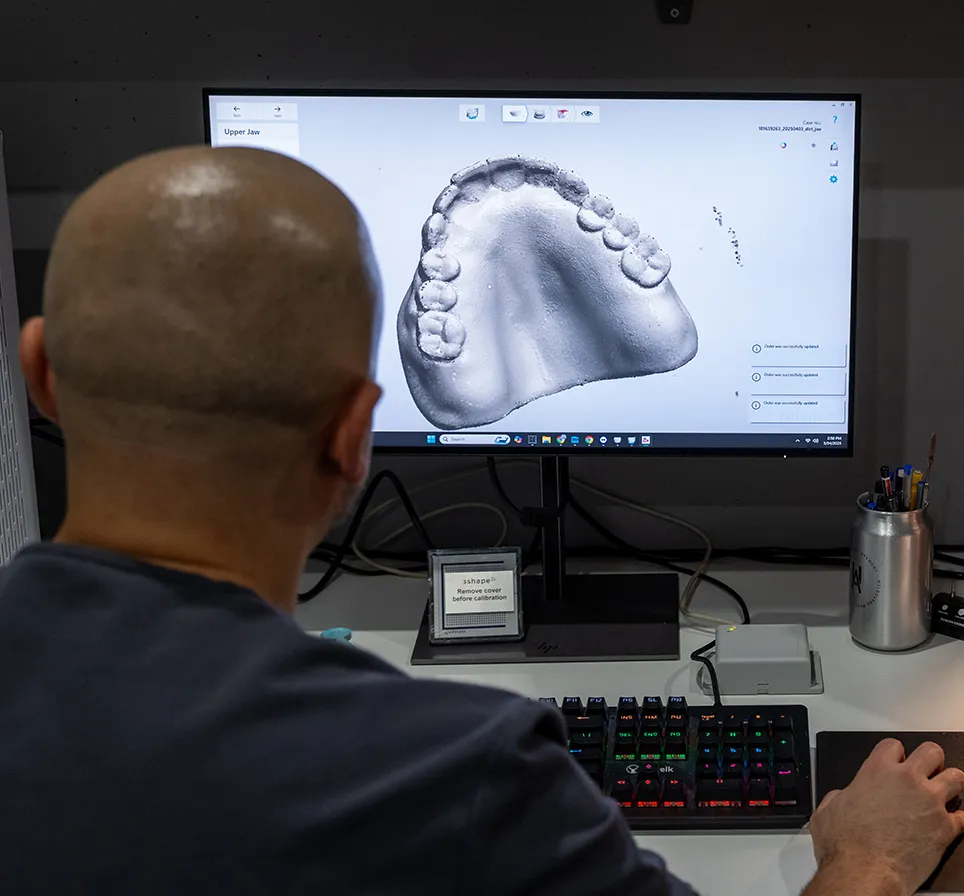
Your initial consultation includes a review of your medical and dental history, an examination of your teeth and gums, and X-rays. A 3D scan (CBCT) is commonly used to check bone height, width and quality, and to map nerves and sinuses. This information shapes a personalised treatment plan, including the number of implants, where they go and the type of final restoration.
Any remaining teeth that cannot be kept may be removed, and gum disease is treated first. Where the jaw bone has shrunk, bone grafting may be recommended to rebuild the area. Grafts need time to heal, which can add months to treatment. Our guide to bone graft healing stages explains this in more detail.
 Dental implant placement is usually done under local anaesthetic by the dentist leading your care. Sedation may be an option for people who feel anxious about dental procedures. During surgical placement, the implants are positioned in the jaw bone through small openings in the gum, following the treatment plan.
Depending on your treatment design, temporary teeth may be discussed for the period straight after surgery. In other cases, the implants are left to heal before any teeth are attached. Your dentist will explain which applies to you.
As the bone bonds to the implants, you may wear temporary teeth. Once healing is confirmed, impressions or scans are taken to make your final teeth, which are designed to fit your bite and the shape of your face.
Research in implant dentistry on full arch dental implants is broadly encouraging, though results always depend on the individual and the quality of planning and care.
A 2021 review of eight studies covering almost 4,000 implants looked at full arch restorations after more than five years. About 97% of implants were still in place, whether they were placed straight or at an angle.
The material used for the final teeth also matters. A 2023 review of full arch zirconia bridges on implants reported an average survival of about 97% over roughly four years. Problems such as small fractures or loose filling material in screw holes were reported but were not common.
Implants still need ongoing care. A 2022 review of peri-implantitis, an infection that causes bone loss around implants, estimated it affects about 1 in 5 patients and about 1 in 8 implants. This is why regular reviews and good cleaning habits are part of long-term care.
Several factors can influence how treatment is planned and how implants perform over time:
Dental implant surgery is a surgical procedure, and like any dental surgery, it carries risks. Possible complications include infection, nerve damage, sinus problems and damage to surrounding teeth. Swelling, bruising and discomfort are common for a few days after surgery.
Implant failure can happen, either early, when an implant does not bond with the bone, or later, often because of infection or overload. A failed implant can sometimes be replaced after the area heals.
Mouth dental implants cost more than most other dental treatments, and fees differ between dental clinics. There is no single price. The dental implant cost for a full arch depends on:
Medicare does not generally cover dental treatment for adults. Some private health insurance policies cover dental implants under major dental extras, but annual limits and waiting periods often apply. It is worth checking your dental insurance before you start.
Looking after implants is a lot like looking after natural teeth, with some extra steps:
Small problems, such as bleeding gums or a loose screw, are often easier to manage when picked up early. Caring for your implants also supports your wider dental health.
 Full mouth dental implants are among the major dental procedures, involving surgery, healing time and ongoing care. For some people they may offer a stable option for replacing missing teeth. For others, an overdenture or another approach may be more suitable. Individual outcomes vary.
If you’d like to explore whether dental implants may be suitable for you, we welcome you to call Crown Dental Group in Ferntree Gully or Narre Warren South.
Crown Dental Group Ferntree Gully
1716 Ferntree Gully Road, Ferntree Gully VIC 3156
Phone: (03) 8771 5188
Crown Dental Group Narre Warren South
11 Tilmouth Place, Narre Warren South VIC 3805
Phone: (03) 7003 2229
Most full arch bridges are supported by four to six implants in each jaw. Some people need more, depending on bone quality and bite forces. Implant procedures are planned around each person’s mouth. An implant-supported overdenture may use two to four implants. Your dentist will recommend a number after a 3D scan.
Treatment usually takes several months from planning to final teeth. Implants generally need around three months to bond with the bone. If bone grafting is needed first, treatment can take longer.
Whether dental implants are worth it depends on your health, bone, budget and goals. Some people value the stability of fixed teeth, while others prefer a removable option. Discussing the pros, risks and costs of each option with your dentist can help you decide.
Some private health insurance policies cover part of the cost under major dental extras. Limits, waiting periods and rebates vary between funds and policies. Ask your dentist for item numbers and check with your fund before treatment.
Often, yes, though it depends on how much bone remains. Options may include bone grafting or placing implants at an angle to use the available bone. A 3D scan helps your dentist work out what may be suitable.
Note: Any surgical or invasive procedure carries risks. Individual outcomes vary. Before proceeding, seek a second opinion from an appropriately qualified health practitioner.


No matter where you are in the south-east, expert care is just around the corner. All clinics offer online booking for your convenience.
With hundreds of 5-star reviews, we’re proud to be one of Melbourne’s most trusted names in dental and denture care.

Take the first step towards a healthier, more confident smile. Book online or contact your nearest Crown Dental Group clinic today.
Book Appointment